
Published: October 2025 | Author: Dr. Maya L. Benton, PhD, Neuropsychologist & Relationship Researcher
🌟 Why Are You Drawn to Some People and Not Others?
Picture this: you lock eyes with someone across a room—and suddenly, something clicks. Your heart beats faster, your palms sweat, and you can’t quite explain why you’re magnetically drawn to them.
That electric feeling? It’s not just “chemistry”—it’s biology, psychology, and evolution working together in milliseconds.

The science of attraction isn’t mysterious or purely luck-based. It’s an intricate blend of hormones, neural chemistry, evolutionary preferences, and social conditioning—layered with cultural influence and individual variation. In this comprehensive guide, we’ll break down exactly what the science of attraction reveals about why certain people captivate you across all identities and relationships, the neurochemistry powering that connection, and how understanding these mechanisms can help you make better romantic choices.
❓ What Is the Science of Attraction?
👉 Quick Answer: The science of attraction explores the biological, psychological, and social processes that determine why people feel drawn to one another—combining hormones, brain chemistry, evolutionary factors, cultural conditioning, and personal preferences.
What Is the Science of Attraction?
The science of attraction isn’t random—it’s an intricate blend of evolution, hormones, neural chemistry, social conditioning, and culture. Researchers describe the psychology of attraction as a multidimensional process involving three overlapping systems:
🧬 Lust — driven by sex hormones (testosterone, estrogen)
💭 Attraction — powered by dopamine and norepinephrine
💕 Attachment — regulated by oxytocin and vasopressin
These systems evolved to ensure species survival: lust encourages mating, attraction narrows focus to a specific partner, and attachment keeps partners bonded for mutual support. However, while biological factors like symmetry and scent create baseline preferences, culture acts as a powerful filter—deciding which traits signal “health” or “status” in each specific society.

The chemistry of love is remarkably consistent across cultures at the neurobiological level, yet profoundly personal in how it manifests for each individual. This duality—universal biology meets individual and cultural experience—is what makes the science of attraction so fascinating and complex.
❓ What Does Research Reveal About the Science of Attraction?
👉 Quick Answer: Brain imaging shows attraction activates reward centers releasing dopamine, while facial symmetry, scent compatibility, and confidence signal health; long-term attraction depends on psychological compatibility, shared values, and how cultural context shapes what we find attractive.
The Science & Research Behind Attraction
Decades of rigorous scientific research have uncovered exactly what happens inside your brain when you fall for someone. This is where the psychology of attraction becomes concrete and measurable.
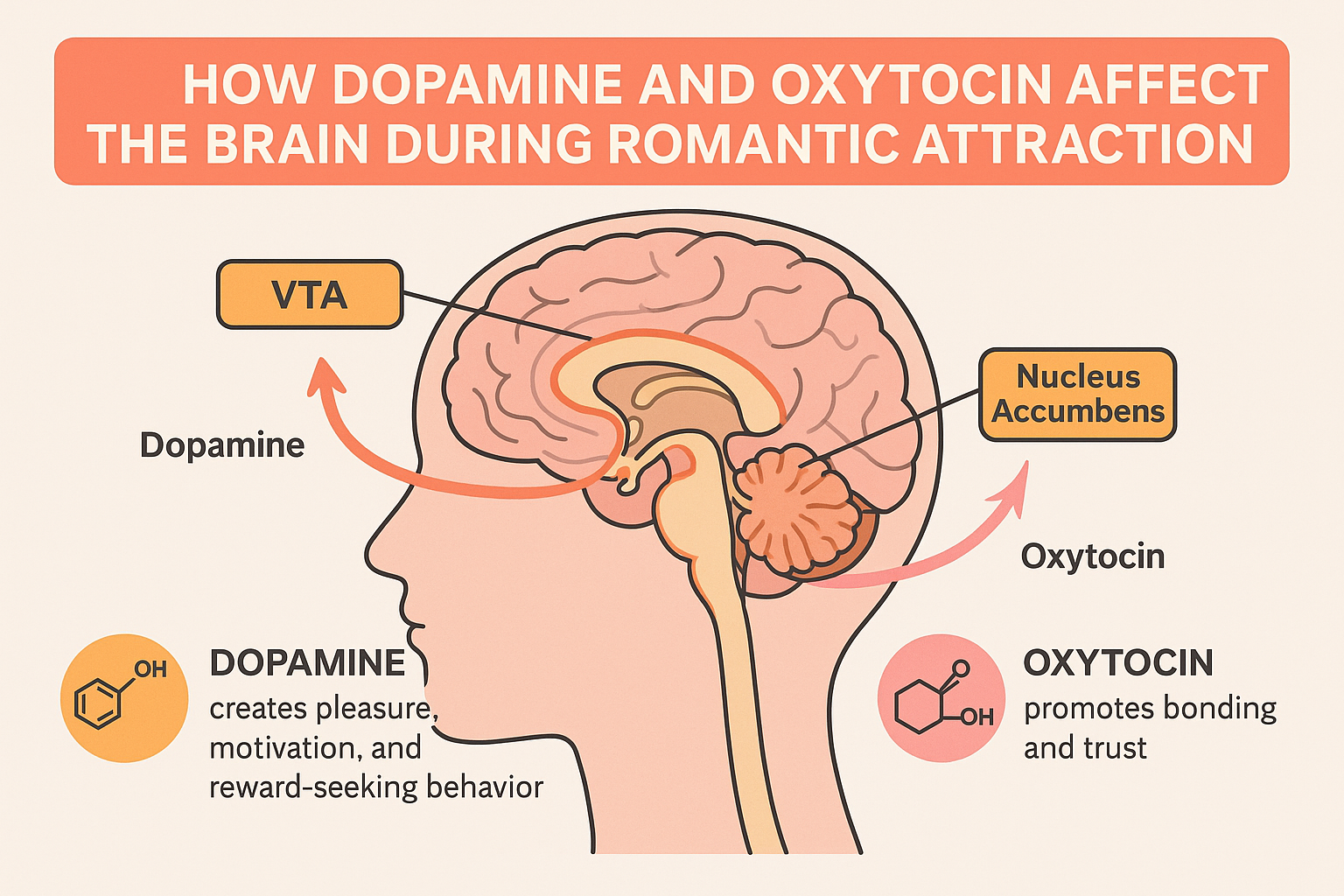
Dr. Helen Fisher, biological anthropologist at Rutgers University, conducted groundbreaking brain imaging studies identifying how love lights up the brain’s reward center—think of it as your brain’s “pleasure headquarters,” the same location activated by chocolate or cocaine. This wasn’t metaphorical; it’s literal neurochemical activation that explains why attraction feels intoxicating.
What happens in your brain during attraction:
🧠 Dopamine creates pleasure, motivation, and reward-seeking behavior—you become intensely focused on the person
⚡ Norepinephrine increases heart rate, blood pressure, and excitement—the “butterflies” sensation
📉 Serotonin actually decreases (which explains why you obsessively replay conversations)
A 2019 study published in Frontiers in Psychology found that facial symmetry and scent compatibility play critical roles in the chemistry of love—both linked to genetic compatibility. People unconsciously prefer partners whose immune system genes differ from their own (detected through scent), which the body recognizes as genetically advantageous for offspring.
Research from the University of Sussex discovered that vocal quality significantly influences attraction. The underlying mechanism: voice signals confidence and health. However, how this manifests varies across gender identities and sexual orientations. In heterosexual contexts, certain vocal patterns correlate with hormones; in same-sex attraction, vocal authenticity and expressiveness become the primary attraction signal; and in nonbinary contexts, comfort with identity and genuine self-expression matter more than conformity to gendered vocal patterns.
A 2020 study from the University of Vienna confirmed that people unconsciously prefer partners whose immune genes differ from their own—enhancing offspring immunity. Your body literally recognizes compatible genetics through scent alone; this is the science of attraction at its most elegant.

❓ Who Benefits from Understanding the Science of Attraction?
👉 Quick Answer: Singles identify genuine connections, couples rekindle desire, people of all identities understand their patterns, therapists apply biological insights, and individuals with attachment trauma recognize unhealthy cycles.
Who Needs to Understand the Science of Attraction?
Understanding the psychology of attraction helps virtually everyone navigate relationships and personal connections more effectively.
💑 Singles and People Seeking Connection: Distinguish genuine psychological connection from dopamine-driven infatuation; make conscious choices rather than impulse-based decisions
👥 Couples and Long-Term Partners: Rekindle early-stage chemistry by understanding what triggers attraction and how to maintain novelty and connection
🏳️🌈 LGBTQ+ Individuals: Recognize that the same biological mechanisms (dopamine, oxytocin, attachment) function identically regardless of gender identity or sexual orientation—what varies is how different people express and experience attraction
🧠 Therapists, Coaches & Relationship Professionals: Apply biological and psychological insights to improve relationship counseling and attachment-based interventions
🔄 Individuals with Attachment Trauma: Recognize repetitive attraction patterns rooted in early bonding experiences; understand why you might gravitate toward emotionally unavailable partners despite knowing it’s unhealthy
💼 Dating App Users: Recognize that initial chemistry (lust/dopamine) differs fundamentally from lasting compatibility (attachment/psychological connection)
Knowledge equals empowerment. Understanding the “why” behind your attractions enables healthier, more intentional choices aligned with your actual values.
❓ How Does Attraction Work? The Step-by-Step Process
👉 Quick Answer: Attraction triggers in milliseconds through visual symmetry processing, scent signal detection, vocal quality assessment, and neural dopamine release, creating focused attention and physical arousal.

How Does the Science of Attraction Actually Work?
Attraction happens in milliseconds—faster than conscious thought. Here’s the precise sequence:
Stage 1: Visual Processing (0-0.2 seconds) Your brain processes facial symmetry, expressions, and micro-movements instantly. Symmetry signals genetic health; bright eyes and clear skin signal youth and vitality; confident posture signals competence. None of this requires conscious evaluation—it’s automatic neurological processing.
Stage 2: Scent Signals (Ongoing) Deep in your nose sits a special sensory detector—your body’s “genetic compatibility radar,” scientifically called the vomeronasal organ. It picks up invisible chemical signals (pheromones) that assess whether someone’s immune system complements yours. You don’t consciously notice this; your body conducts the assessment automatically.
Stage 3: Vocal Quality & Confidence Vocal quality signals health and confidence. The underlying mechanism works across all gender identities—whether someone presents masculine, feminine, or authentically nonbinary, your brain registers vocal authenticity and confidence as attractive signals.
Stage 4: Neural Reward Activation The brain’s reward system floods with dopamine, creating pleasure and reinforcing attention. You become laser-focused on this person; everything else fades to background. This is why attraction literally changes your perception of reality.
Stage 5: Physical Arousal Heart rate increases, pupils dilate, blood flow shifts—your autonomic nervous system prepares for connection. These aren’t conscious choices; they’re automatic responses.
The entire process from first sight to dopamine rush takes less than a second, yet it sets off a cascade of neurochemical and hormonal changes lasting for months.
✨ How the Science of Attraction Works Across All Gender Identities and Sexual Orientations
The biological mechanisms of attraction—dopamine, oxytocin, scent compatibility, confidence signaling—function identically regardless of the genders or identities involved. What changes isn’t the neurobiology; it’s the signals being processed.
Same-Sex Attraction: Two people of the same gender experience the same dopamine/oxytocin systems as heterosexual couples, but the specific signals (confidence, vulnerability, how someone presents themselves) may differ from heteronormative patterns. A person might be powerfully attracted to another person’s soft femininity or masculine presentation—the neurochemistry is identical; the expression differs.
Nonbinary and Gender-Diverse Attraction: People attracted to nonbinary partners report being drawn to authenticity, self-knowledge, and comfort with identity rather than conformity to gendered appearance. The brain’s reward system responds to these qualities identically to how it responds to traditional gender presentation.
The Science: Attraction mechanisms are universal across all identities and orientations. The expressions of those mechanisms vary across sexual orientation, gender identity, and individual preference. Your dopamine responds to genuine confidence and authenticity whether that’s expressed traditionally masculine, traditionally feminine, or authentically nonbinary.
🧬 The Biological and Evolutionary Roots of Attraction
Why are certain traits universally attractive? Evolutionary psychology offers compelling answers about the chemistry of love.
Facial symmetry signals genetic health and developmental stability. Asymmetrical faces often result from developmental stress or genetic challenges, while symmetry suggests optimal health.
Pupil dilation signals subconscious interest and arousal. Your pupils dilate automatically when you see someone attractive; this signals attraction before conscious awareness.
Clean, natural scent communicates genetic diversity and immune compatibility. Your body detects immune system genes through smell, seeking genetic diversity for offspring strength.
Confidence and upright posture signal survival fitness and status. In evolutionary terms, confident individuals had access to resources and could provide protection.
Clear skin, bright eyes, energetic presence signal youth and fertility in biological terms. Even though modern humans don’t reproduce solely on these factors, your ancient brain still registers them as quality indicators.
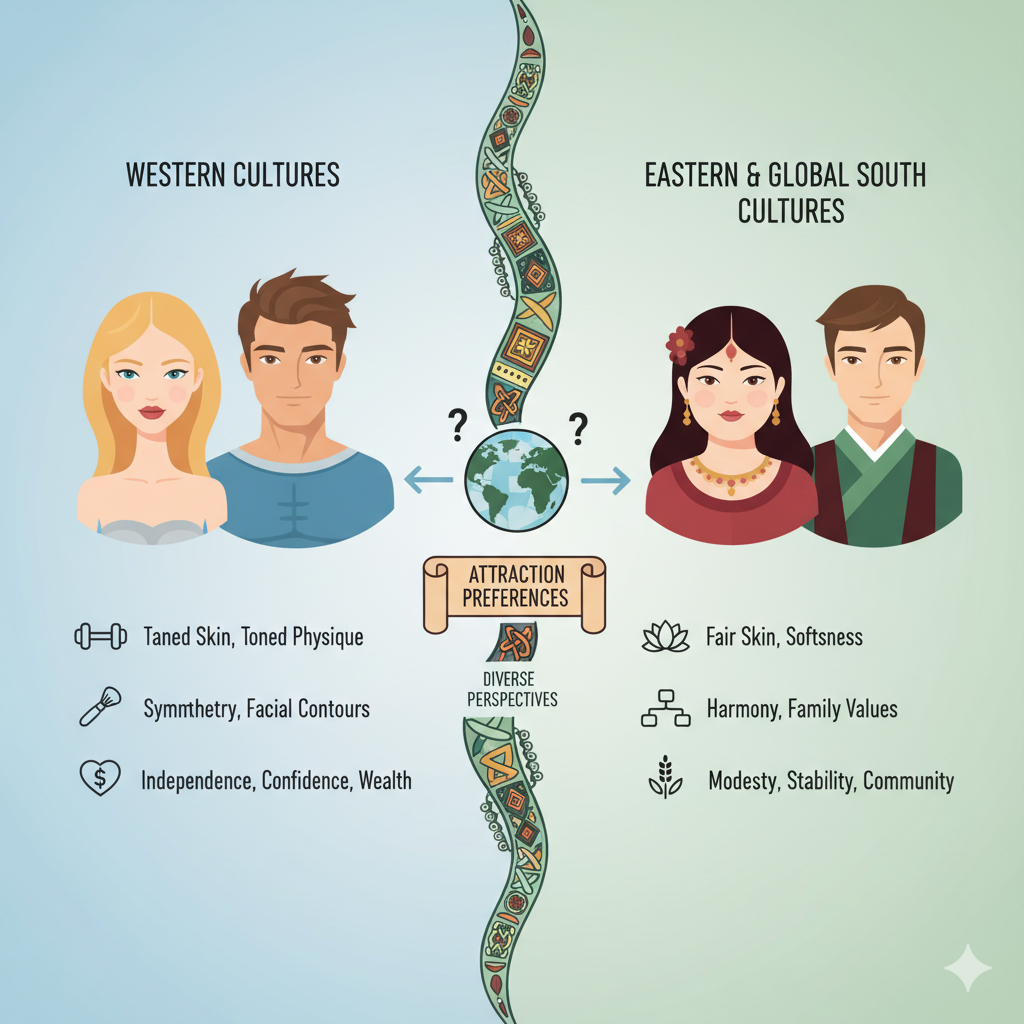
These evolutionary preferences form the foundation, but culture builds the walls. A person might have evolved preference for health signals, but their culture decides whether health = thinness or health = muscularity; whether status = individual confidence or status = group harmony.
🌍 How Culture Shapes the Science of Attraction
While evolutionary biology provides the foundation for attraction—symmetry, health indicators, genetic compatibility—culture builds the expression of these preferences. The science of attraction is neither purely biological nor purely cultural; it’s a dynamic interaction between the two.
Body Size & Wealth Signals In Western media, thinness signals wealth and status (you have time and resources to exercise). Historically, in many African, Middle Eastern, and South Asian cultures, a fuller body signaled fertility, financial security, and access to abundant food—markers of reproductive success. The attraction preference isn’t hardwired; it’s cultural learning shaped by economic context. As globalization spreads Western media, younger generations increasingly prefer thinner body types, demonstrating that “biological” preferences actually shift with cultural exposure.
Skin Color & Colonial Legacy Light skin preference in many Asian, African, and Latin American cultures isn’t evolutionary—it’s colonial legacy. Lighter skin historically signaled freedom from outdoor labor, marking higher social status. Centuries later, these preferences persist despite their cultural rather than biological origins. The science of attraction reveals how powerfully culture can override biology: people literally train themselves to find attractive what their society tells them is beautiful.
Gender Expression & Confidence The underlying biology—confidence signals status and competence—remains constant. However, how confidence manifests varies dramatically by culture. In some cultures, emotional expressiveness and vulnerability are more attractive in people of all genders. In Nordic countries with greater gender equality, willingness to engage in childcare and domestic partnership is a strong attraction signal. In more hierarchical cultures, different expressions of status and competence are attractive. The neurochemistry is identical; the cultural interpretation differs profoundly.
Family Involvement vs. Individual Choice In individualistic Western cultures, personal attraction and choice drive mate selection. In collectivist cultures, family approval, economic compatibility, and social fit may override personal attraction. This isn’t less biological—it’s the same attachment and bonding systems responding to different cultural values. A person can be attracted to someone personally but choose not to pursue them if family disapproves, because their attachment system prioritizes family stability over individual chemistry.
Media’s Accelerating Effect The beauty standard shift from the 1950s (curvaceous) to 1990s (ultra-thin) to 2020s (athletic curves) demonstrates that culture isn’t just influencing attraction—it’s rapidly reshaping what humans find attractive within single generations. This speed is too fast to be evolutionary; it’s entirely cultural and media-driven. Social media’s global reach accelerates this further, homogenizing beauty standards even as resistance movements push for diverse representation.

💞 Benefits and Advantages of Understanding the Science of Attraction
When you understand the science of attraction and the psychology of attraction at their foundations, you gain concrete advantages in romantic relationships and personal decision-making.
💡 Better Self-Awareness in Choosing Partners Understanding your attraction patterns helps recognize whether you’re drawn to someone for genuine compatibility or repetitive trauma patterns. Are you attracted to emotionally unavailable people? The science of attraction explains why—and provides the framework to break that cycle.
❤️ Improved Communication and Intimacy Knowing that eye contact increases oxytocin, that genuine laughter triggers mirror neurons, and that physical touch amplifies bonding hormones gives you concrete tools to deepen connection. You’re not guessing; you’re applying neuroscience.
🧩 Enhanced Sexual Connection Understanding that novelty maintains dopamine and that vulnerability increases oxytocin helps couples maintain desire long-term. The chemistry of love doesn’t have to fade—it can evolve and deepen.
🧘 Emotional Regulation and Realistic Expectations Knowing that infatuation ≠ lifelong compatibility protects you from major life decisions during the dopamine-high phase when critical thinking is suppressed. You can enjoy the spark while evaluating actual compatibility.
📈 Increased Relationship Satisfaction Research shows couples who understand attraction science report higher satisfaction, fewer conflicts around “lost spark,” and more intentional efforts to maintain connection.


⚠️ Potential Drawbacks and Risks of Attraction Science
Understanding the science of attraction also reveals why we sometimes make problematic relationship choices. Awareness of these pitfalls protects you:
🔴 Addictive Chemistry The dopamine surge in early love literally mimics addiction—activating the same neural pathways as substance abuse. This can lead to obsession, poor judgment, and staying in unhealthy situations. A Harvard Medical School review (2021) warned that emotional highs of romantic attraction mirror substance addiction so closely that people can become neurochemically dependent on relationship drama.
🔴 Trauma Bonding and Anxious Attachment People with anxious attachment styles often confuse intensity for intimacy. The psychology of attraction research shows that chaotic, unpredictable relationships trigger higher dopamine spikes (unpredictability creates stronger reward responses), which can trap people in harmful dynamics.
🔴 Hormonal Bias and Rose-Colored Glasses High dopamine literally suppresses activity in the prefrontal cortex (your rational brain). During early attraction, you’re neurologically incapable of objective assessment. Red flags become invisible; incompatibilities seem minor; manipulative behavior reads as passionate.
🔴 Mistaking Chemistry for Compatibility Two people can have incredible physical chemistry while being completely incompatible on values, life goals, and emotional maturity. The science of attraction shows these are separate systems—good chemistry doesn’t predict relationship success.
🔄 Alternatives and Complementary Factors in Attraction
While the chemistry of love and biological factors play major roles, psychological and emotional attraction are equally—if not more—vital for long-term relationship success.
Types of Attraction Beyond Physical:
🧠 Intellectual Attraction: Stimulating conversation, shared curiosity, respect for intelligence. Research shows this is one of the strongest predictors of long-term satisfaction.
❤️ Emotional Attraction: Deep understanding, vulnerability, feeling truly seen and accepted. This builds slowly and becomes increasingly important over time.
🌱 Spiritual Attraction: Shared beliefs, values, or life purpose. Couples aligned on “why we’re here” report significantly higher satisfaction.
🎨 Aesthetic Attraction: Appreciation of how someone presents themselves, their style, their energy—distinct from sexual attraction.
The Reality: Physical chemistry ignites connection, but psychological safety, shared values, and genuine understanding sustain it long-term. Couples who maintain strong attraction decades into relationships typically report that they became more attracted as emotional intimacy deepened—the science of attraction evolved from dopamine-driven to oxytocin-driven bonding.
🧭 How to Use the Science of Attraction in Real Life
Want to leverage the science of attraction ethically and effectively? Here are concrete, neuroscience-backed strategies:
Be Authentically Confident Genuine confidence (not arrogance) releases oxytocin in both you and others. Authenticity is attractive because it signals emotional safety and genuine self-worth. Fake confidence triggers defensive responses. This applies across all gender identities and orientations.
Maintain Excellent Hygiene and Natural Scent Skip overpowering fragrances that mask natural pheromones. Instead, maintain excellent hygiene and consider subtle, clean fragrances that amplify rather than obscure your natural scent. Your natural scent is literally your genetic signature.
Maintain Genuine Eye Contact Eye contact increases oxytocin production in both parties, deepens connection, and signals genuine interest. Sustained eye contact (3-5 seconds) is more powerful than glancing.
Regulate Your Stress High cortisol (stress hormone) suppresses attraction-related neurotransmitters. Stressed people are literally less attractive and less capable of forming connection. Sleep, exercise, and stress management increase attractiveness.
Smile Genuinely A genuine smile (involving the eyes, not just mouth) activates mirror neurons in others’ brains, fostering warmth. Fake smiles trigger suspicion.
Create Shared Novel Experiences Novelty maintains dopamine. Couples who regularly try new activities together report higher attraction and satisfaction. The brain’s reward system responds to newness.
Practice Active Listening and Emotional Validation These behaviors increase oxytocin and deepen psychological attraction. Being truly heard and understood is deeply attractive across all relationship types.
Maintain Physical Touch (Appropriate to Context) Appropriate touch (hand-holding, hugging) triggers oxytocin release, increasing bonding and attraction. Physical connection is literally neurochemical bonding.
🧩 Expert Tips & Best Practices
🔹 Dr. Helen Fisher’s Insight: “Sustained attraction depends on novelty—shared new experiences keep dopamine flowing. Couples who stop exploring together often report ‘losing the spark.’ It’s neurologically starved of novelty.”
🔹 Dr. John Gottman’s Research: Emphasizes emotional bids—small acts of attention and responsiveness. When your partner reaches out (verbal or nonverbal), responding warmly strengthens bonding and attraction.
🔹 Mayo Clinic Study (2022): Laughter, touch, and mutual goals increase long-term attraction by boosting oxytocin and creating positive association memories.
Best Practices from Research:
✨ Stay genuinely curious about your partner—ask questions, listen deeply, remain interested in their evolution
✨ Express appreciation daily—specific, genuine appreciation triggers reward responses
✨ Keep playfulness and flirtation alive—this maintains dopamine and novelty
✨ Maintain individual identity and interests—interdependence (not codependence) maintains attraction
✨ Address conflict directly and repair ruptures—secure attachment actually increases attraction
✨ Maintain physical health—this signals respect for self and partner
✨ Create rituals of connection—daily check-ins, weekly dates, regular intimacy
🧠 The Bottom Line: Understanding the Science of Attraction
The science of attraction proves that love is both art and biology—and when you understand both, you can create bonds that genuinely last.
Attraction isn’t luck. It’s neuroscience, hormones, psychology, and evolution converging in powerful ways. By understanding why you’re drawn to certain people, you gain something precious:
🆓 Freedom from repeating unhealthy attachment patterns
🆓 Freedom to build deeper, more intentional connections
🆓 Freedom to love consciously—integrating chemistry with compatibility, passion with partnership
The chemistry of love is real and universal in its neurobiological mechanisms. The psychology of attraction is complex and culturally shaped in its expression. When you combine self-awareness with neurobiological knowledge, you transform your romantic life from something that happens to you into something you actively create—regardless of your gender identity, sexual orientation, or relationship structure.
❓ FAQ: The Science of Attraction (Schema-Optimized for Featured Snippets)
Q1: What is the science of attraction and why does it matter? A: The science of attraction explores how biological (hormones, brain chemistry), psychological (personality, values), and cultural factors determine romantic attraction. Understanding it helps you make better partner choices, recognize unhealthy patterns, and build stronger connections regardless of your identity or orientation.
Q2: What hormones and neurotransmitters are involved in the chemistry of love? A: Four key players: dopamine (pleasure, motivation), norepinephrine (excitement, focus), oxytocin (bonding, trust), and vasopressin (long-term attachment). Sex hormones (testosterone, estrogen) also influence lust-stage attraction. These function identically across all genders and sexual orientations.
Q3: Can you control who you’re attracted to, or is it just biology? A: You can’t fully control initial biological attraction, but self-awareness helps distinguish genuine compatibility from attachment trauma patterns. You have significant agency in choosing who to pursue and nurturing attraction with.
Q4: What triggers instant physical attraction according to the psychology of attraction? A: Eye contact, facial symmetry, confident body language, natural scent, and vocal authenticity trigger dopamine and norepinephrine release. These signals process in milliseconds—before conscious awareness. However, what’s considered attractive varies across cultures and individuals.
Q5: How long does romantic attraction typically last? A: The dopamine-driven “attraction” phase typically peaks within 6–18 months. After that, attachment hormones (oxytocin, vasopressin) take over. This isn’t “losing the spark”—it’s the relationship maturing into genuine love.
Q6: Is the chemistry of love purely physical, or does personality matter? A: Both matter, but research shows psychological and emotional compatibility often outweigh physical traits for long-term satisfaction. Physical chemistry ignites connection; personality and values sustain it. Intellectual, emotional, and spiritual compatibility become increasingly important over time.
Q7: Why do I keep attracting the same “type” of person? A: Repetitive attraction patterns typically stem from subconscious attachment styles developed in childhood. If you grew up with emotionally unavailable parents, your nervous system may recognize that dynamic as “familiar” and thus attractive, even if unhealthy.
Q8: Does the science of attraction work the same for LGBTQ+ relationships? A: Yes—the neurobiology (dopamine, oxytocin, attachment systems) functions identically regardless of the genders or identities involved. Attraction mechanisms are universal across all sexual orientations and gender identities. What varies is how different people and communities express attraction and what signals they find appealing.
Q9: Does the science of attraction work the same in all cultures? A: The biological foundations (symmetry, scent compatibility, confidence signals) are universal, but how culture interprets and prioritizes these signals varies dramatically. Beauty standards shift faster than evolution—proving that much of what we think is “biologically hardwired” is actually culturally learned. Media, economic factors, and social values all shape what’s considered attractive.
👩🔬 Author Bio
Dr. Maya L. Benton, PhD
Neuropsychologist | Relationship Researcher | Science Communicator
Dr. Benton holds a PhD in Neuropsychology from UCLA and has spent 15 years studying the neuroscience of love, emotion, and attachment across diverse populations. Her research on emotional cognition and human bonding—including work on same-sex and nonbinary relationship neuroscience—has been published in the Journal of Social and Personal Relationships and related peer-reviewed journals. She regularly contributes to Psychology Today and Scientific American, and lectures internationally on relationship neuroscience. Dr. Benton is passionate about translating cutting-edge neuroscience into accessible guidance that serves people of all identities and orientations.
⚖️ Medical & Ethical Disclaimer
This article is for educational and informational purposes only and is not a substitute for professional psychological, medical, or therapeutic advice. While this content is based on peer-reviewed research and expert insights, individual experiences vary significantly. If you’re struggling with relationship issues, attachment trauma, or concerning attraction patterns, please consult with a licensed mental health professional, therapist, or counselor who can provide personalized assessment and guidance.
The science of attraction is a dynamic field with ongoing research. Findings continue to evolve as neuroscience advances.